Musculoskeletal rehabilitation
After surgery, an accident or with persistent pain in the musculoskeletal system, we support you step by step on your way back to everyday life.
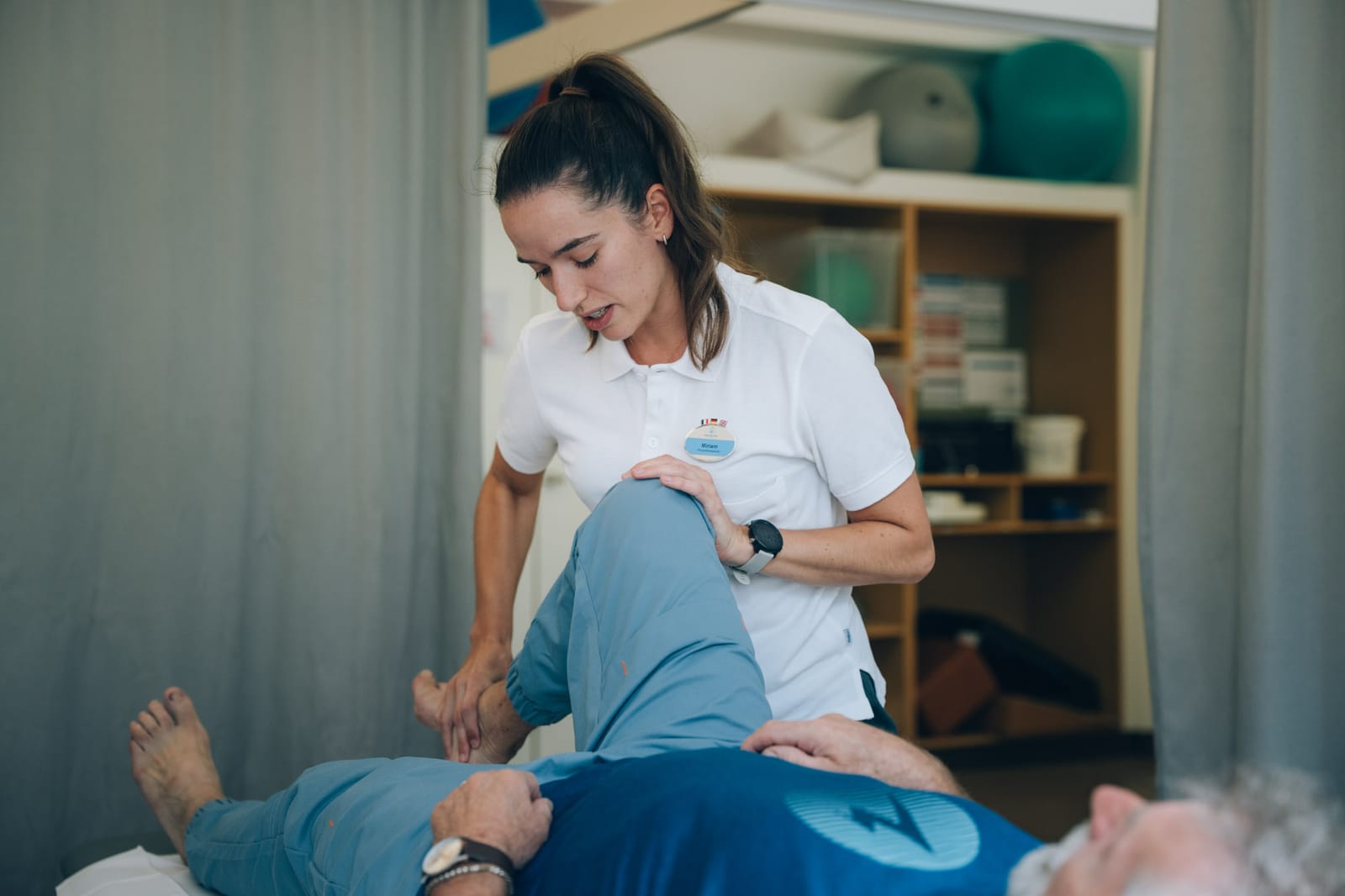
The clinic provides personalised medical follow-up for patients of all ages and fitness levels, whether staying for post-operative recovery or for the treatment of musculoskeletal disorders of any aetiology. Patients on post-operative rehabilitation stays benefit from a complete convalescence process.
Following surgery: description of the main operations requiring a musculoskeletal rehabilitation stay
For disorders of the musculoskeletal system: description of the main conditions and problems for which a musculoskeletal rehabilitation stay can be beneficial
Following surgery
Arthroscopy
Arthroscopy is a minimally invasive surgical technique used to diagnose and treat joint injuries or diseases. It is performed under regional or general anaesthesia, which is why the patient must be fasting beforehand. The surgeon makes small skin incisions to introduce the arthroscope (a small tube about the width of a pencil, fitted with a camera and a light source) along with miniature surgical instruments. This makes it possible to carry out the procedure under camera guidance; the space within the joint is slightly widened by introducing air or a special fluid, which is drained by suction at the end of the operation.
Arthroscopy is used for diseases and injuries, particularly of the shoulder or knee, whether affecting the ligaments, tendons or meniscal structures. It has become a routine procedure, with markedly lower risks than open surgery.
Joint prostheses
Fitting a prosthesis involves replacing an entire joint (total prostheses) or only the damaged parts of a joint (partial prostheses) with artificial components that are both durable and well tolerated by the body. The prosthesis is fixed to the bone with surgical cement, although some prostheses are uncemented.
Prostheses can be considered for almost any joint, but especially the hip, knee or shoulder, and less often the ankle or hand.
Fitting a prosthesis is a major procedure that requires substantial rehabilitation work afterwards, but it has a high success rate, allowing patients to go on to lead an almost normal functional life, with little or no pain. To maintain a good result in the long term, it is essential to continue physical exercise and stay active.
Osteosynthesis
Osteosynthesis means the reassembly of bone fragments. These are fixed using screws, plates, nails or wires, allowing stable consolidation. The material used can in principle remain in the body for life and is generally not removed, except in certain patients and/or situations where it is poorly tolerated and impairs function.
Healing time after a fracture is at least 6 weeks, but it can take several months. Partial loading and mobilisation with the help of crutches or supports is generally possible and advisable beforehand; physiotherapy exercises prevent joint stiffening or muscle wasting.
Osteotomy
In an osteotomy, a bone is cut in a controlled way so that it can be realigned and held, for consolidation, in the desired position. Realignment can be achieved by removing a wedge of bone (closing-wedge osteotomy) or by opening a wedge-shaped gap in the bone (opening-wedge osteotomy). This procedure is carried out to correct bone and joint deformities, mainly of the knee and hips. The aim is to rebalance the pressures on an area affected by osteoarthritis, a cartilage lesion or a malformation, thereby reducing pain and significantly postponing a more major procedure such as fitting a prosthesis.
As with the reduction of a fracture, full recovery varies from a few weeks to several months, depending on the extent of the surgery and the patient's response.
Foot and ankle surgery
In a severe sprain, ligament rupture can occur or, in the event of a direct impact, bone injuries that require surgery. The procedure aims to reposition and fix the bone fragments and, if necessary, suture the torn ligaments. After the operation, mobilisation (first passive, then active and assisted by physiotherapy) must begin promptly. The healing process allowing full weight-bearing generally takes between six and eight weeks, although this varies from case to case.
Spinal surgery
Spinal surgery is probably still the type of surgery that causes patients the most anxiety (more or less well founded). It is used when conservative treatments are no longer sufficient, and minimally invasive surgical techniques are now available.
In adults, most indications leading to spinal surgery are related to ageing, for example a herniated disc, osteoarthritis, vertebral compression, or a spinal deformity such as scoliosis or kyphosis (see also the section on pathological deformities of the spine).
Surgery for a herniated disc can be performed endoscopically. A small skin incision is made to the side to introduce the endoscope and the miniature surgical instruments used to remove the herniated material. In microsurgery, the skin incision is made on the back, but here too the procedure is minimally invasive. Only when the intervertebral disc is too badly damaged is it replaced with a prosthesis, through open surgery. As a last resort, the surgeon will perform spinal fixation, or spinal fusion: the disc or bone tissue compressing the nerves is removed and the vertebra is fixed with rods and screws that stabilise the spine until the vertebrae fuse together.
After the procedure, strengthening the back muscles and optimal pain control are essential for the long-term success of treatment. Physiotherapy and targeted back exercises, dosed and supervised by professionals including sports therapists, are essential. Rehabilitation aimed at avoiding poor posture is also absolutely necessary.
For disorders of the musculoskeletal system
Main conditions affecting the joints
Rheumatism: one word, up to 200 different conditions
Osteoarthritis
Osteoarthritis is the most common joint disease. Articular cartilage, the smooth, elastic "cushion" between two bones, progressively deteriorates, causing the bones to rub against each other, which can be very painful and severely limit mobility. Osteoarthritis can occur in the knees, hip, feet, ankles, spine, shoulders, elbows, wrists, fingers and hands. There are many causes: age, being overweight, poor posture, excessive strain on the joints, but genetic and hormonal factors also play a role. In addition, inflammatory or metabolic diseases can induce osteoarthritis. The first signs of the disease are pain or "cracking" in the joint used, morning stiffness, or swollen joints. There is currently no cure for osteoarthritis. Treatments aim, on the one hand, to relieve pain and, on the other, to slow its progression.
Rheumatoid arthritis
Rheumatoid arthritis is the most common inflammatory autoimmune rheumatic disease. It progresses in flares towards the deformation and destruction of the affected joints, mainly of the hands and feet. Its causes are not yet known; women are affected three times more often than men, the disease has a hereditary and possibly hormonal character, and tobacco and stress are identified as risk factors. Being inflammatory in nature, the symptoms of the disease are pain, redness and swelling as well as a sensation of warmth in the joints, but also fatigue or a mild fever. It, too, is an incurable disease; treatments aim to relieve pain and slow its progression.
Ankylosing spondylitis, or Bechterew's disease
Ankylosing spondylitis is an inflammatory autoimmune rheumatic disease. It was the Russian neurologist Vladimir Bekhterev (1857–1927) whose description allowed it to be classified as a distinct form of rheumatism. Inflammation first affects the sacroiliac joints, the two joints of the pelvis, which have little mobility and connect the pelvic bones to the spine. From these joints, the inflammation can spread to the whole spine. It attacks the cartilage; the intervertebral discs and ligaments can stiffen and ossify. The joints of the arms and legs, the tendons, the eyes and internal organs can also be affected by the inflammation. It generally appears in young people between 15 and 35 and first shows itself as dull, recurring pain in the lower back at night or in the morning. It can progress slowly and stop spontaneously, or develop through inflammatory flares followed by remission. The exact causes of the disease are not known and it cannot be cured. As its progression is highly individual, treatments must be tailored to each patient; regular exercise to prevent stiffness nonetheless remains an absolute basis.
Fibromyalgia
Fibromyalgia is an enigmatic form of rheumatism; although many hypotheses have been put forward in an attempt to explain this disease, its origin remains unknown. It affects middle-aged people, mainly women. Its symptoms, too, are difficult to define precisely: widespread musculoskeletal pain, fatigue and sleep disturbances are the three most significant symptoms of fibromyalgia, but patients may also suffer from, among other things, great sensitivity to cold, circulatory problems, or visual and hearing disturbances. Given the extent and diversity of its symptoms, fibromyalgia proves to be a difficult disease to treat; it requires the patient's active participation and a multidisciplinary approach.
Pathological deformities of the spine
Back pain, the ailment of our century?
Herniated disc
The spine is made up of 24 mobile vertebrae and the sacrum. The vertebrae are separated by the intervertebral discs, which act as shock absorbers. These discs have a central core (nucleus pulposus) held in place by layers of fibres (annulus fibrosus). With ageing, the annulus fibrosus can crack and let the nucleus pulposus through, which then protrudes from the disc. It can then press on the nerves running along the spine and cause inflammation with pain and muscle tension. In the vast majority of cases, a herniated disc does not require surgery; the pain, which can be very intense, can be relieved with medication and targeted physiotherapy, and it usually improves over time.
Spinal canal stenosis
This is a narrowing of the spinal canal through which the spinal cord runs, most often appearing at the lumbar or cervical level. Osteoarthritis is the main cause, but it can also be caused by herniated discs or osteoporotic fractures, for example. Pain in the buttocks or tingling in the thigh or leg while standing or walking is often felt. The discomfort usually disappears when bending forward or at rest. In some cases, patients complain of back pain, in addition to weakness and pain in the legs. Conservative treatments including medication and physiotherapy may be sufficient; otherwise surgery will be considered.
Spondylosis / spondylarthrosis
Spondylosis is a general term for osteoarthritis or arthritis of the spine. It can affect the neck (cervical spondylosis) or the lower back (lumbar spondylosis), more rarely the middle of the spine (thoracic spondylosis). Being a degenerative disease, it mainly affects seniors, although it can affect people from the age of 25. It does not necessarily cause pain; when it does, this is mainly stiffness. However, spondylosis can lead to bone growth that can result in painful vertebral friction and narrowing of the spinal canal (see also spinal canal stenosis). Symptoms are treated with analgesics or, where necessary, stronger medication, and, where possible, with movement carefully dosed through exercise or physiotherapy as well as the application of heat or cold.
Spondylolisthesis
In spondylolisthesis, one vertebra slips relative to the one below it, either forward or backward. This slippage can occur at any level of the spine, but mainly at the lumbar level. The causes are repeated mechanical strain on the spine, trauma, osteoarthritis of the joints, or a congenital malformation. This displacement causes numerous problems: the functioning of the spine is disrupted, its centre of gravity shifts, and nerves may be compressed. The symptoms are persistent lower back pain often accompanied by sciatica. Initial care is both medicinal, with analgesics and anti-inflammatories, combined with back rehabilitation exercises. If this conservative treatment is not sufficient, surgery may be considered.
Scoliosis, hyperkyphosis and hyperlordosis
Scoliosis, hyperkyphosis and hyperlordosis are permanent deviations of the spine. In scoliosis, this is a deviation to the left or right. In hyperkyphosis, the natural curve of the upper spine is exaggerated, the back appears rounded and the chest seems to bend forward. In hyperlordosis, the inward curve of the lumbar or cervical spine is excessive. Underlying conditions, but also poor posture and degenerative diseases such as osteoporosis, can cause these deformities of the spine. Depending on the degree of severity and the patient's age, various treatments will be recommended, such as orthopaedic insoles, physiotherapy, stretching and, possibly, the use of a brace. Surgery is a last resort.
Other bone disease
Osteoporosis
This disease is characterised by a reduction in bone substance and structure. It mainly affects older women, but other factors such as a sedentary lifestyle, being underweight, smoking, alcohol and certain medications can make it worse. The disease does not cause pain; signs such as a stooped back due to vertebral compression, back pain, or a marked reduction in height can raise the alarm about osteoporosis, but it is most often only diagnosed after a fracture.